
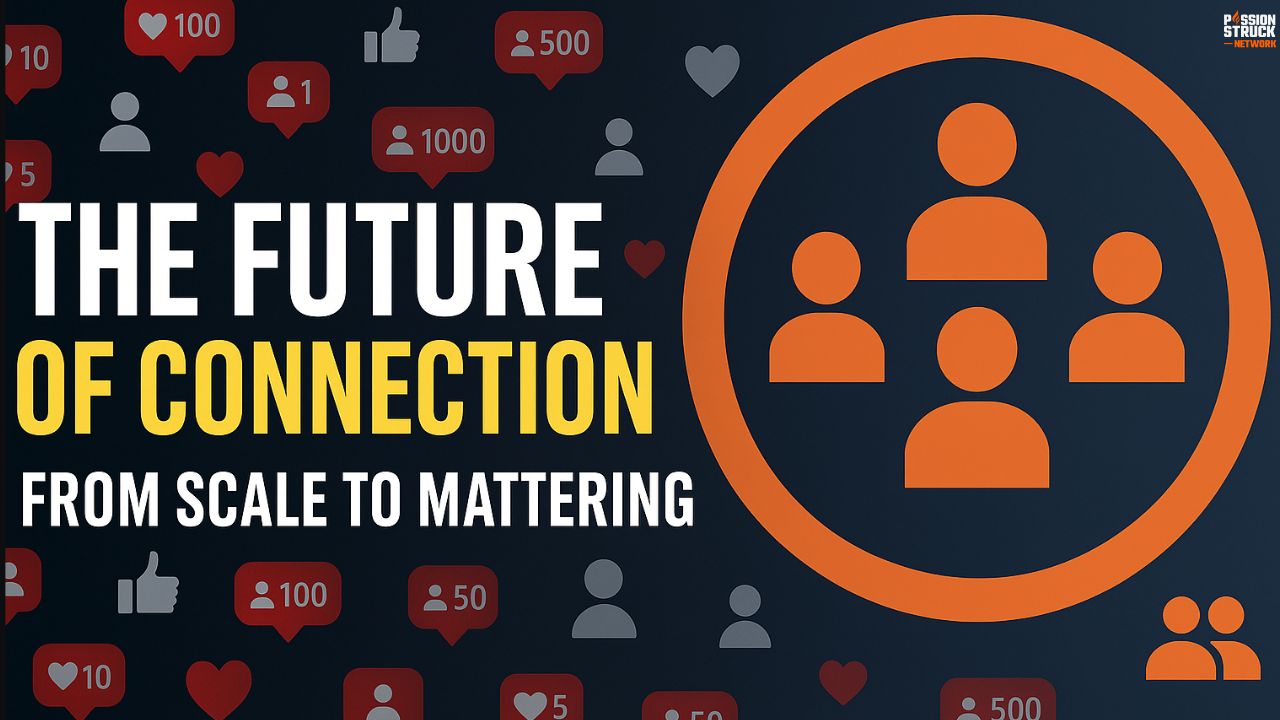
The internet taught us to worship scale. Followers, downloads, impressions, and more were always better. But the future of connection won’t be measured by scale. It will be measured by significance.
Every era builds its defining infrastructure. The 19th century laid the railroads that connected towns and trade. The 20th century built highways and power grids that fueled the growth of industry. The 21st century is building the infrastructure of human connection.
But the question is not whether we will connect. It’s how. Will our infrastructure be shallow, optimized for clicks and fleeting attention? Or will it be deep, designed for trust, mattering, and transformation? The answer will shape not only the creator economy but culture itself.
The Future of Connection Will Be Measured in Mattering
Take the story of Maria, who has more than a million followers on Instagram. She posts daily, racks up thousands of likes, and is often told she’s “killing it.” Yet when she faced a crisis last year, she realized none of those connections felt like people she could call.
Her story reflects a paradox of modern life: in an era of unprecedented connectivity, many people feel unseen and insignificant. The internet has given us scale. What it hasn’t given us is a sense that we matter.
The current infrastructure was designed for attention. Platforms maximize clicks, time-on-screen, and engagement. That system has produced extraordinary reach, but scale is a poor substitute for significance. It connects us in proximity while leaving us unanchored in meaning.

The Old Infrastructure of Connection
Take the story of Maria, who has more than a million followers on Instagram. She posts daily, racks up thousands of likes, and is often told she’s “killing it.” Yet when she faced a crisis last year, she realized none of those connections felt like people she could call.
Her story reflects a paradox of modern life: in an era of unprecedented connectivity, many people feel unseen and insignificant. The internet has given us scale. What it hasn’t given us is mattering.
The current infrastructure was designed for attention. Platforms maximize clicks, time-on-screen, and engagement. That system has produced extraordinary reach, but scale is a poor substitute for significance. It connects us in proximity while leaving us unanchored in meaning. The future of connection cannot be built on numbers alone.
Why Mattering in the Creator Economy
For years, scale has been regarded as a measure of influence. Politicians boast of followers. Influencers trade likes for brand deals. Advertisers pitch impressions. Yet the cracks are showing.
Loneliness and disconnection are at record highs, even as online interactions multiply. Attention is fleeting; it doesn’t translate to loyalty or trust. And audiences themselves are signaling fatigue with shallow feeds, craving something slower, more intentional, and more human.
Mattering is the experience of feeling noticed, valued, and significant. The sense that one’s presence makes a difference. Unlike attention, which can be bought, mattering is earned. Unlike scale, which can be vast but empty, mattering is intimate and lasting.
Social scientists argue that the need to matter is as fundamental as the need for safety. People who feel they matter are more resilient, healthier, and more connected to others. In communities, mattering is the glue that transforms audiences into movements. It is what the future of connection must measure.
The Micro-Moments That Build It
Alison Wood Brooks, professor at Harvard Business School and author of Talk: The Science of Conversation and the Art of Being Ourselves, has studied how people form bonds. Her research shows that mattering often emerges not in sweeping declarations but in micro-moments: a follow-up question, a flash of empathy, the way someone mirrors your words.
“Our evidence to ourselves and to other people that we matter and that they matter so often happens during our conversations, in these little tiny moments,” she explained.
These small, repeated signals accumulate into trust. They are the bricks of building communities that matter — and they cannot be automated. If scale was the past, these micro-moments are the future of conne
Human Connection in the Digital Age
Charles Duhigg, Pulitzer Prize–winning journalist and author of Supercommunicators, has reached a similar conclusion. His research indicates that all conversations can be categorized into three main types: practical, emotional, or social. Miscommunication arises when people think they are having the same conversation but aren’t.
The lesson is striking: large networks fail when they mistake information exchange for connection. People don’t only want data; they want to feel understood.
Communities thrive when dialogue affirms significance, leaving people not only informed but also convinced that they matter. The future of connection will depend not on more communication, but on communication that proves people matter.
The Building Blocks of Communities That Matter
If past centuries were built on steel and concrete, the infrastructure of connection must be built on three human materials:
- Trust. The confidence that a person’s vulnerability will be respected.
- Mattering. The assurance that one’s presence is noticed and valued.
- Impact. The proof that participation makes a difference.
Communities that rest on these foundations endure. They generate loyalty that algorithms cannot force and cultural change that impressions cannot measure.
The Fragility of Scale
Scale still has power. A message broadcast to millions can shape elections, markets, and movements. But scale without mattering is fragile. Audiences drift. Trust collapses. What lasts are communities where people feel they count.
The most influential movements of our time, from grassroots activism to creator collectives, are built less on reach than on resonance.
The Future We Choose
Infrastructure doesn’t emerge by accident. Past generations chose where to lay tracks, pave highways, and string power lines. We now face a similar decision about how to wire our connections.
We can keep building systems optimized for noise, or we can construct networks designed for mattering. We can measure success by how many people see something, or by how many people are changed by it.
Maria, with her millions of online “friends,” illustrates the failure of the old model. She is not alone. The infrastructure of scale has made us visible to one another but not significant to one another.
The future of connection is the opportunity to change course. Communities that matter can become the power grid of this century, fueling culture, commerce, and human flourishing.
That is the vision we are building toward. At the Passion Struck Network, we exist to amplify voices that matter and to create ecosystems where significance outweighs scale. Our commitment is simple: the next era of the creator economy must be measured not in impressions, but in mattering — and we’re here to help lead that change.